
- BVH Editor
- 0 Comments
Bayview Hospital has long understood that the people who are often hardest to get through the door of a medical practice are the very ones who need it most. The busy executive. The entrepreneur whose calendar is booked three months out. The professional who is always the one holding things together — and who quietly assumes their health can wait until things slow down. It never does.
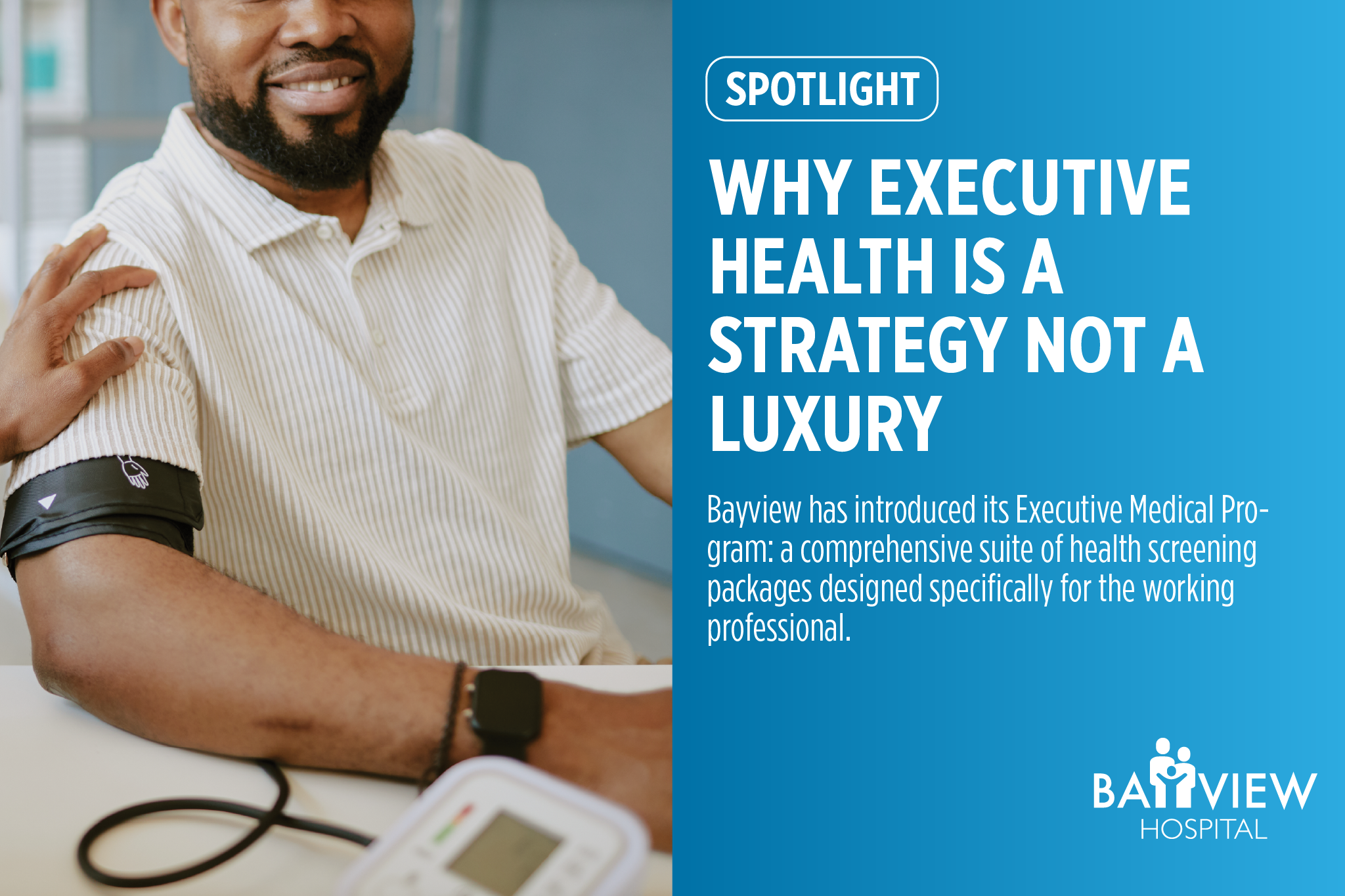
In response, Bayview has introduced its Executive Medical Program: a comprehensive suite of health screening packages designed specifically for the working professional. Delivered in a private, comfortable setting and tailored to different levels of need — from foundational screenings to full preventive assessments — the programme is built around one simple premise: that investing in your health is not a luxury, it is a strategy. Early detection saves lives. It also saves organisations the far greater cost of losing a key person without warning.
One well-known local businessman knows only too well what the price of neglecting that principle can be. His story is not one of ignoring obvious warning signs. It is something more unsettling than that — and far more common.
He is not the kind of man who slows down. Active, driven, and playing a sport every day after work, he appeared by every outward measure to be in robust health. But in November 2025, during a business trip to London, a conversation with a close friend — an interventional cardiologist — changed everything. The friend had been urging him to get a CT coronary angiogram for years. This time, he finally said yes.
It was, as he would later reflect, the most important decision he ever made.
A CT coronary angiogram is a non-invasive imaging test that produces detailed three-dimensional pictures of the arteries supplying blood to the heart. Using a powerful CT scanner and a contrast dye injected into the bloodstream, it allows cardiologists to see the coronary arteries with exceptional clarity — revealing narrowing, blockages, calcification, and plaque build-up that would otherwise be completely invisible.
Unlike a standard ECG or exercise stress test, which measures how the heart performs under strain, a CT angiogram shows the actual anatomy of the arteries themselves. It can detect disease years before symptoms appear, and long before a crisis occurs.
This matters because coronary artery disease — the gradual narrowing of the heart’s arteries — is one of the world’s leading causes of death, and a frightening number of cases present with no warning symptoms whatsoever. There is no chest pain, no shortness of breath, no signal that anything is wrong. For many people, the first sign is a heart attack.
This executive is a striking example of exactly this. An active man in his prime, playing a sport daily, with no obvious cardiac symptoms. And yet what presented internally could have been catastrophic.
The scan was performed and he was not expecting much. But that same night, his cardiologist friend called.
The results were alarming. He had a 90 percent blockage in his main coronary artery and a 70 percent blockage in a second vessel. Without intervention, the risk of a massive cardiac event — a heart attack or sudden death — was severe. The cardiology team recommended immediate open heart surgery: a coronary artery bypass, a major procedure requiring weeks of recovery.
“He told me I was basically a walking dead man,” he recalls, with the measured calm of someone who has had time to process just how close things came.
His mother and several family members — all doctors — strongly urged him not to proceed without a second opinion. He listened.
A second opinion was sought and the conclusion differed significantly. The blockages, while serious, were considered suitable for a far less invasive approach: coronary artery stenting.
Rather than open heart surgery, he underwent a percutaneous coronary intervention (PCI) — a procedure in which a catheter is guided to the blocked artery and a tiny mesh stent is deployed to restore blood flow. Recovery is measured in days, not months. He underwent the procedure and thankfully is alive and well today.
An experience like this would cause anyone to make lifestyle changes and he has done just that. He now eats red meat no more than once a week. His relationship with food — and with time — has shifted profoundly.
“This has been a wake-up call,” he says. “I am eternally grateful that I made the decision to take my friend up on his offer. It has made me want to spend more time with my family, and to do the things I have been putting off.“
He still plays a sport. But now he does so knowing exactly what his heart looks like — and knowing that it has been given every chance to keep beating.
He was fortunate: the right friendship, the right moment, and the wisdom to finally say yes to a scan he had deferred for three years. Not everyone will have that opportunity.
Bayview Hospital’s Executive Medical Program exists so that no one should have to depend on luck. With packages ranging from foundational health screenings to comprehensive preventive assessments — including CT Cardiac Calcium Scoring for those over 40 — the program is designed to find what the body does not announce.
Further investigation and testing is done in collaboration with other clinical specialists as necessary utilizing their experience and wisdom for guidance.
And for those who, like this local businessman, want the most complete picture possible, Bayview is working to bring CT coronary angiography on-site which will be assessed through referral in conjunction with one of the cardiologists in the near future — so that the scan that saved his life will not require a trip to London to access.
Heart disease does not always send a warning. But a scan can. The question is whether you will book it before or after you need it.
For information on the Executive Medical Program contact:
Contact info: +1(246) 436-5446
[email protected]